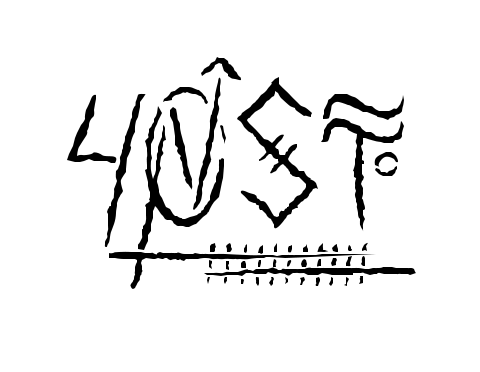
Mythos

The Lost 40s are mystical places that have been forgotten by time. These locations still possess old-growth forests that managed to survive the widespread clear-cutting that occurred in the 1800s. The prairies were never burned or tilled for agricultural purposes, so the harmony between plants, animals, and humans remained intact. Many people view these areas as being deeply spiritual and sacred.
The existence of the Lost 40s was an accidental occurrence. Land surveyors on the American frontier were tasked with dividing newly acquired land from Native Americans into a comprehensive grid system of private ownership. They worked under the assumption that land was divided into sections, with quarter-sections measuring 160 acres and quarter-quarter sections measuring 40 acres. In 1832, the 40-acre quarter-quarter section became the smallest parcel of land that could be acquired and became deeply ingrained in American mythology. The phrase "Back 40," which refers to farm fields, indicates the back quarter-quarter section of land.
However, the surveyors of the time had a shaky grasp of mathematics and were required to work quickly. A simple mistake in mathematical theory resulted in the creation of many "lost 40s." These mysterious, peculiar parcels of land seemed to pop up out of nowhere. They had no private owner, and according to the government, they did not even exist.
The mistake occurred when people began measuring off their half-sections and quarter-sections of land. Folks in the west township started measuring from the center of town to the east, while folks in the east township were measuring from the center of town to the west. At the point where the west township should have reached the fence of the neighboring east township, they did not.
For some reason, there was a tract of land located between the borders of the two townships that should have been touching. Nobody noticed this, and people just assumed that their neighbor was not fencing in their whole property, which would have been quite labor-intensive at that time.
The breakdown in theory occurred because of one simple fact: the number of acres in a section was thought to be constant at 640 acres. In reality, the number of acres available per section varies depending on the terrain of the land.
When land surveyors laid down the grid system of squares, they did so by drawing lines on a map. They drew intersections at the same distances between two points and laid out the whole grid accordingly, effectively measuring distance "as the bird flies."
However, when people on the land measured off their 40-acre plots, they did so by walking the land. Due to elevation changes, such as rolling hills or mountain sides, many more acres actually existed than originally thought. These lands between the borders were spared the burden of private ownership. No farmer had to pay off a banker, so the forest was never cleared to sell the lumber as a source of income. Because there was no farmer, the prairies were never burned off to break ground for fields. In this way, the land was saved.
These unclaimed sections of land did not go unnoticed by everyone. Native people who were forced into government-assigned camps eventually started to leave and, one by one, returned to their homeland. These early scouts took refuge in the overgrown and unclaimed areas of the countryside. They developed a system of hidden trails with secret markers guiding the way so that other Native people could find their way to safe camping grounds.
In the northern states, migrant farm workers were often homeless and would move around, squatting on random sections of land. Eventually, they found their way to the lost 40s where the native safe camps were located, and an unlikely friendship was born out of necessity. Migrant workers helped the natives establish which farms were native-friendly, and the natives shared their system of symbols with the migrant workers so they could always find a safe place to camp.
Then something peculiar happened. Runaway slaves began using the secret trails to escape into the northern states. Migrant workers in border states taught some slaves how to find and use the hidden symbols, and they used them to elude danger, find safe camps, and even hunt and fish. They even found their way into safe houses that had good relations with natives. Farmers at safe houses started to use the trail symbols by weaving variations into quilts that they hung outside their home or in town to guide runaways. This system of trails, camps, and safe houses became known as the Underground Railroad.
Although the Underground Railroad was not a real railroad, trains were used in some cases to transport runaways. With the expansion of the railroad and the end of the Civil War, there was a large influx in the number of migrant workers. The underground trail system continued to expand until it connected with many "Jungles." Migrant workers called hobos would camp out in jungles, which are overgrown areas near train tracks. These camps made it easy to hop out and illegally ride freight trains.
It was in jungles where notes about train yards and the trail systems were shared and eventually assembled into a book commonly called the "crew change." Not everyone's crew change was the same, and they were always growing and changing. Train Doc copyrighted the information and assembled it into a typed booklet called "An Alternative Hiking Guide to North America." It is forbidden to publish, sell, or make digital copies of this booklet. It is still used in modern times. A copy of a crew change must be given by an experienced rail rider who believes a person has proven their knowledge and experience to ride the rails safely and will only share the knowledge with trusted friends. It is seen as very dangerous for a crew change to fall into the wrong hands.
During World War II, the Japanese American Internment Camps were established. Most people who were in these camps had nothing to do with the war and were forced into camps simply because of their heritage. Some of these people who had lived through the Dust Bowl and Depression remembered that they could travel long distances undetected by rail. They used the trail system to lead people into the safe camps of the lost 40s.
The lost 40s were not just hiding places; they were multicultural common grounds. Anyone could live freely and travel regardless of their heritage or social status. There were no cops, no government, and no money. Food and lodging were always free in the woods. Many intellectuals occupied these spaces, and people passed the time by reading books, sharing ideas, creating art, music, and culture.
It was rumored that a chief recognized the safe camps as similar to an ancient prophecy. He rejoiced that the four brothers, the Red, the White, the Black, and Yellow, had returned home to live as one family. This omen was the sign of a new era, one in which people's actions would return the earth to its former beauty, and peace and prosperity would prevail for all people.
A new era was dawning, as the philosophies of renowned writers such as Ralph Waldo Emerson, Henry David Thoreau, Margaret Fuller, and Jack Kerouac began to gain popularity among America's youth. A fresh idealism was taking root, as the Beatniks and Hippies, mostly the offspring of middle-class families, awakened to the realization that society had a long history of committing human rights abuses.
Middle-class youngsters began to ride the rails and congregate in the lost 40s, not out of necessity as refugees, but out of a genuine desire to experience the lifestyle. Over the ensuing decades, some of these safe camps grew exponentially from a few hundred inhabitants to populations exceeding 10,000 individuals in a single camp.
In the 1990s, the federal government acknowledged that these camps were entitled to protection under the First Amendment as a form of religious freedom.